Program closing symposium
The DIME project is inviting you to our closing symposium at Ghent University on the 9th of April.
This in-person symposium has as its aim to bring together researchers addressing issues related to the objectives of DIME in bioethics, medical ethics, and the philosophy of technology. In addition to contributions from current DIME members, the discussion will be enriched by our two keynote speakers: Jeroen Hopster (Utrecht University) and Simona Tiribelli (University of Macerata).
📆 Practical information
When: 9/04/2026, 9h-16.10h
Where: Faculty library of Arts and Philosophy, Library Lab Magnel, Rozier 44, Ghent (Belgium)
Participation is free. Lunch and coffee breaks are included.
📋 Register here: https://event.ugent.be/registration/DIME
More information on our program below.
09:15 – 10:00 Keynote: Simona Tiribelli (Chair Heidi Mertes)
Session One: From Empowerment to Freedom (Chair Michiel De Proost)
10:00 – 11:00
- Jesse Gray: On mobile health-driven empowerment
- Sara Laurijssen: Rethinking Ethical Review Criteria for Research and Clinical Care
- Steven Gouveia: Artificial Intelligence & Health: From Prediction to Justification
11:00 – 11:30 Coffee
Session Two: From Prediction to Responsibility (Chair Jasper Debrabander)
11:30 – 13:00
- Lien De Proost: When Better Prediction Is Not Better Care: Prognostic Models and Non‑Subsidiary Investments for Decisions at the Limit of Viability
- Brandon Ferlito: Power, Privilege, and Moral Responsibility
- Mónika Nogel: The Trust Gap in Disruptive Genomics: Clinical Validity, Secondary Use, and Shifting Responsibilities
- Lieke van Kempen, Martine C. de Vries & Nienke de Graeff: The Moral (Un)Desirability of Stem Cell Therapy as a Potential Techno‑Fix
13:00 – 14:00 Lunch
Session Three: From Marginalization to Justice (Chair Brandon Ferlito)
14:00 – 15:00
- Kristina Lekić Barunčić: AI‑Driven Diagnostics and Epistemic Marginalization: Moral and Epistemic Responsibility in the Age of Disruptive Technology
- Michiel De Proost: Rethinking Epistemic Data Solidarity in Healthcare
- Rosemarie van den Breemer & Ana Koncul: Wilful Ignorance of Genuine Joy: Affective and Epistemic Disruption in Healthcare Ethics
15:00 – 15:15 Coffee
15:15 – 16:00 Keynote Jeroen Hopster: On the need to rethink applied ethics in the face of Socially Disruptive Technologies (Chair Michiel De Proost)
16:00 – 16:10 Closing: Heidi Mertes
Call for abstracts: Disruption in healthcare and medical ethics: are we there yet?
The ERC-funded project DIME, led by Prof Heidi Mertes (Ghent University), is glad to announce its closing conference: Disruption in healthcare and medical ethics: are we there yet?
Medical ethics has traditionally evolved alongside conventional medicine, but recent so-called “disruptive” innovations in healthcare, such as AI-driven diagnostics, digital twins and personalized genomics, raise pressing questions about whether existing ethical frameworks are still adequate. These innovations are often framed as promises of improving access to high-quality care while safeguarding patients against new risks. However, risks associated with those innovations extend beyond clinical outcomes to potential violations of deeply rooted concepts in medical ethics such as respect for patient autonomy, duty of care, privacy, solidarity, and justice. And what are we to think of the increasing emphasis on empowerment, trust and responsibility?
Over the past five years, the DIME project addressed these challenges with the objectives to (i) locate the most prominent ethical disruptions, (ii) provide arguments for and against adaptations to our medical ethics toolbox and (iii) critically analyse the shifting moral responsibilities in healthcare as a consequence of disruptive innovations.
The aim of this conference is to bring together researchers addressing issues related to the objectives of DIME in bioethics, medical ethics, and the philosophy of technology. In addition to contributions from current DIME members, the discussion will be enriched by our keynote speaker: Jeroen Hopster (Utrecht University), a leading expert on topics central to the conference theme.
We invite researchers to submit abstracts of up to 300 words on subjects relevant to the conference. Submissions from underrepresented groups are particularly encouraged. Proposed presentations should be suitable for a 20-minute talk. Please send abstracts by e-mail to: Michiel De Proost (Michiel.deproost@ugent.be).
Conference attendance is free of charge.
Important Dates:
- Conference: 9 April 2026 (in-person at Ghent University)
- Deadline for submission: 31 January 2026
- Notification of acceptance: 9 February 2026
Throwback to our Brocher Workshop
In January, we had two inspiring days at the Fondation Brocher on “Shifting responsibilities in healthcare due to disruptive innovation”.
Take-home messages:
– Jeroen Hopster talked about conceptual disruption
– Nathan Cortez gave us insights about how digital health is regulated in the USA and touching on difficult questions, e.g. should the use of generative AI in healthcare medical be regulated as medical practice? As medical product? Can medical facilities function as gatekeepers?
– julian cockbain and Sigrid Sterckx explored the DABUS case: Can an AI be an inventor? Can the person instructing AI be granted a patent on an AI generated invention?
– Ruth Chadwick explored the notions of solidarity and equity in the context of commercial involvement in biobanking and genetics research. Informing participants in research about different types of commercial involvement is necessary, yet challenging.
– Matthias Braun talked about (data) solidarity as a practice that needs constraints in order to function in a positive way.
– Daniel Tigard explored ways to tackle concerns about the alleged responsibility gap caused by AI in healthcare: Should citizens be better educated about the fittingness of seeking blame/praise in this context? Should we focus more on taking responsibility and less on blame?
– Mahsa Shabani evaluated to what extent regulators succeed in addressing fairness in the secondary use of health data.
– Karin Jongsma illustrated how the expected positive and negative impacts of digital health technologies don’t always correspond to reality, and how some unexpected effects occur, such as delegation of patient monitoring from GPs to nurses, and patients gaming the system.
– Safia Mahomed walked us through the hurdles for the introduction of digital health on the African continent: legal (e.g outdated legislation), cultural (e.g. mistrust of international policy documents and an underrepresentation of African principles), and practical (power cuts).
– Patricia Cervera de la Cruz presented her great research on the concept of fairness in the secondary use of health data. We need to focus on the balance of interests, power asymmetries, commercial involvement and benefit sharing.
– Gabrielle Samuel dived into the environmental sustainability of data driven health research. Take-aways: “the cloud” is all but soft and fluffy, and digital technologies come with problematic mining practices, high energy consumption, and e-waste.
Thanks again to all the speakers and participants who contributed to the success of our workshop in Geneva.
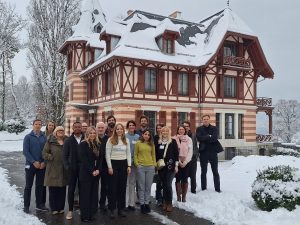

Brocher Workshop in January
The DIME team is organising a workshop on the shores of Lake Geneva on the topic of “Shifting responsibilities in healthcare due to disruptive innovation: ethical, legal, and social implications”. The event will take place from Wednesday 10 January to Thursday 11 January 2024 at the Brocher Foundation in Hermance, Switzerland.
Click here to find the final programme, which we hope you will be as excited about as us!
100 ERC grantees at UGent celebration
As Ghent University reached the milestone of hosting 100 ERC grantees, all ERC grant holders were celebrated, including Heidi Mertes and our DIME project!
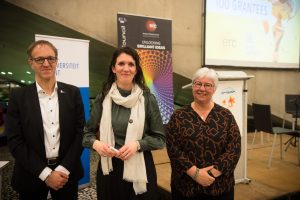
© UGent, photo Nic Vermeulen
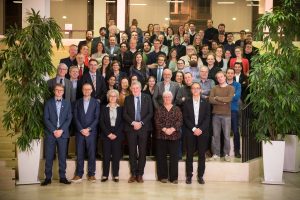
© UGent, photo Nic Vermeulen